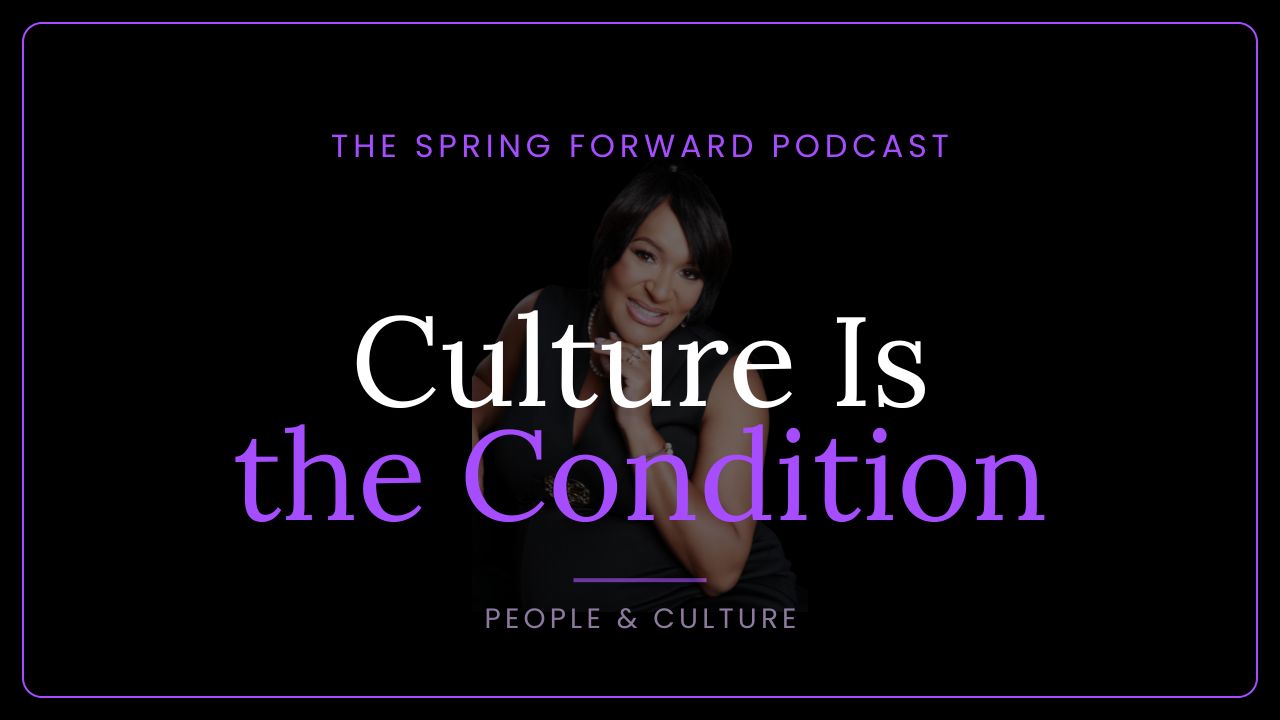
Culture is the Condition
I want to tell you something that took me years to fully understand, and that I now believe is one of the most important truths in organizational development.
You cannot manage your way to employee engagement. You can only build the conditions for it.
That distinction changes everything about how you lead, how you plan, and how you understand the relationship between the people in your organization and the work they do together.
Today, I want to zoom out to the question that sits behind all of it: What makes people actually want to give their best at work? Not because they're required to. Not because someone is watching. But because they genuinely care about what they're doing and believe their contribution matters.
That's employee engagement. And it lives — or dies — in your organizational culture.
What Employee Engagement Actually Is (And What It Isn't)
Let's be honest about something: "employee engagement" has become one of those phrases that gets thrown around in leadership meetings and HR reports until it starts to feel meaningless. We measure it with annual surveys, post the scores in staff newsletters, and call it a day.
But engagement isn't a score. It's a state of being.
Researchers define employee engagement as the degree to which employees are cognitively, emotionally, and behaviorally invested in their work and their organization. Think about what that really means: it's not just whether someone shows up and completes their tasks. It's whether they bring themselves to those tasks: their creativity, their judgment, their care, their energy.
And here's what the research tells us with remarkable consistency: engaged employees produce better outcomes. They are more productive, more innovative, more likely to stay, and more likely to bring others up with them. Organizations with high engagement consistently outperform those without it. Not by a little, but significantly.
In my own doctoral research, I explore the relationship between organizational culture and work environments. Specifically, how the norms, values, and practices embedded in a culture shape the conditions that either support or suppress people's ability to contribute fully. I am deep in this work and can't wait to share my findings when I'm officially done with the research.
The environment you build, the way decisions get made, the way mistakes are handled, the way voices are heard (or not heard), the way people are recognized and developed, is your culture. And your culture is the single most powerful predictor of whether your team is engaged or just employed.
The Three Cultural Conditions That Determine Engagement
In my work with nonprofits, schools, and community-based organizations, I've observed that engagement tends to rise or fall based on three core cultural conditions. None of them require a big budget. All of them require intentional, sustained leadership.
1. Psychological Safety
Amy Edmondson's research on psychological safety has been transformative for how we understand high-performing teams. Psychological safety is the shared belief that it is safe to take interpersonal risks, to speak up, ask a question, admit a mistake, or challenge an idea, without fear of humiliation or punishment.
In organizations with low psychological safety, people protect themselves. They stay quiet in meetings. They don't flag problems early. They work around each other instead of with each other. They do what's safe, not what's right. And they are almost never fully engaged.
In organizations with high psychological safety, people invest themselves. They bring their real perspectives. They catch problems early because they trust they won't be penalized for surfacing them. They collaborate genuinely. And they are far more likely to go above and beyond. Not because they're told to, but because they feel safe enough to care.
Creating psychological safety is a leadership practice first. It starts with what you model. Do you admit when you're wrong? Do you genuinely invite pushback on your ideas? Do you respond to difficult truths with curiosity or defensiveness? Your team is watching, and they are calibrating their own behavior accordingly.
2. Meaningful Connection to Purpose
Human beings need to know that what they're doing matters. This is especially true in mission-driven organizations such as nonprofits, schools, and community organizations where people often accept lower salaries and longer hours because they believe in the work. But belief in the mission isn't enough on its own. People need to see the line between their daily work and the larger impact.
When that line is visible and felt, engagement soars. When it's obscured by bureaucracy, unclear priorities, or the relentless grind of reactive work, it fades.
I think about conversations I've had in my work, teams that were technically resourced and operationally sound, but where people had lost the thread between what they did on Tuesday morning and why any of it mattered. That loss of connection is cultural. And recovering it is a cultural intervention.
3. Voice and Valued Contribution
The third condition is perhaps the most overlooked: the experience of having voice that matters. Not just the opportunity to speak, but the experience that what you say is heard, considered, and genuinely influences what happens.
Many organizations believe they have voice built in. They have suggestion boxes. They have town halls. They have annual engagement surveys. But if staff members share concerns and nothing changes, if they offer ideas and they disappear into a leadership black hole, the mechanism for voice becomes, over time, a mechanism for disengagement. It signals, through action rather than words: your input is appreciated in principle, but not actually valued in practice.
The organizations I've seen do this best are not the ones with the most formal voice structures. They're the ones where leaders have developed the discipline of closing the loop; regularly communicating back to staff what they heard, what changed as a result, and what didn't change and why. That honesty, even when the answer is "we heard you and still can't make this change right now," builds more trust than silence ever could.
The Leadership Dimension: You Are Your Culture
On The Spring Forward Podcast, I've had the privilege of exploring these themes with some extraordinary guests. In Episode 37, "Wellness for Nonprofit Leaders," Serena Sabala said something I keep coming back to: self-care for leaders isn't optional. It's a prerequisite for effective service. She was talking about burnout, but the deeper truth she was pointing to is this: leaders who are depleted cannot build cultures of engagement, because culture is built through presence, relationship, and intentionality, all of which require capacity that burnout destroys.
This is a loop that doesn't get talked about enough. Disengaged cultures create burned-out leaders. Burned-out leaders create disengaged cultures. And somewhere in that cycle, the mission suffers — not because anyone stopped caring, but because the structural and cultural conditions that allow caring to translate into impact were never built or were allowed to deteriorate.
Breaking that cycle requires leaders who understand that their own wellbeing is inseparable from the health of the culture they steward. And it requires organizations that structure leadership support — not just leadership performance management — into their everyday operations.
From Culture to Engagement: A Practical Starting Point
I'm aware that all of this can feel large. Culture change is not a weekend project. So let me offer something concrete: a starting point that doesn't require a consultant, a budget line, or a strategic planning retreat.
Start with a listening session.
Not a survey. Not a check-in item at the end of a staff meeting. A genuine, dedicated, 90-minute conversation with your team, or a cross-section of your team, where the only agenda is to understand what it feels like to work there right now.
Ask three questions:
1. What's one thing about our culture that makes you proud to be part of this organization?
2. What's one thing that gets in the way of you doing your best work here?
3. If you could change one thing about how we operate together, what would it be?
And then here's the critical part: listen without defending. Do not explain. Do not contextualize. Do not problem-solve in the room. Just receive what you hear, thank people for their honesty, and commit to reporting back on what you learned and what you're going to do about it.
That single act of asking and genuinely listening does something that no survey can replicate. It signals that you see your team. That you care about their experience. That their voice has weight. And in doing so, it begins to shift the cultural conditions that determine whether engagement is possible.
It is, as I often say, not a comprehensive solution. But it is a real beginning.
Why This Is Your Productivity Strategy
I'll close with this, because I think it needs to be said plainly:
If you are leading an organization that is struggling with productivity such as output, quality, follow-through, accountability, innovation, or any of the outcomes that determine whether your mission actually lands, and you are looking for technical solutions to those problems, I want to gently redirect your attention.
The technical solutions might help. But if your culture doesn't have the conditions for engagement if people don't feel safe, connected to purpose, or genuinely heard, the technical solutions will only get you so far. Because performance, at its deepest level, is not a systems problem. It is a human one.
And humans perform at their best not when they are managed more tightly, but when they are supported more intentionally. When the culture around them says, in a thousand small and large ways: you matter here, your work matters here, and we are in this together.
That is organizational culture at its best. And that is the foundation on which real, sustained employee engagement is built.
The next several posts in this series will go deeper — into specific cultural practices, into how engagement connects to your grant writing and strategic planning, and into what the research tells us about building environments that don't just retain people but genuinely develop them. I'm glad you're on this journey with me.
Related Resources:
- 🎙️ The Spring Forward Podcast — Episode 37: "Wellness for Nonprofit Leaders" (featuring Serena Sabala on burnout prevention and sustainable leadership)
- 🎙️ The Spring Forward Podcast — Episode 39: "The Business of Nonprofits" (featuring Karria Lawrence on organizational structure and strategic planning)